Best LLM for Coding in 2026: Claude Opus vs GPT-5 vs DeepSeek V4 (Benchmarks + Free Credits)
Head-to-head coding benchmarks for Claude Opus 4.6, GPT-5, and DeepSeek V4. SWE-bench scores, real-world tests, cost analysis, and free credit sources.
The AI Coding Wars of 2026
Developers are splitting into factions. Claude Code loyalists claim nothing else can touch a 50,000-line refactor. GPT-5 advocates swear by its code generation speed. DeepSeek fans run circles around both camps on cost efficiency.
The truth is all three models have legitimate strengths for coding — and the data backs it up. This guide puts Claude Opus 4.6, GPT-5, and DeepSeek V4 through every coding benchmark that matters, compares real-world performance across common development tasks, and shows you exactly where to get free credits to test each one yourself.
No vendor loyalty. Just benchmarks, code, and cost math.
TL;DR: Claude Opus 4.6 leads on SWE-bench (72.5%) and is the best choice for complex coding tasks. GPT-5 is competitive and better for code generation from specs. DeepSeek V4 delivers 85-90% of frontier coding performance at 1/10th the cost. The smart move is testing all three with free credits before committing to one.
Coding Benchmark Showdown (April 2026)
Benchmarks aren't everything, but they're the closest thing to an objective measure we have. Here's how the three models perform across every major coding evaluation.
SWE-bench Verified (Real-World Bug Fixing)
SWE-bench is the gold standard for measuring practical coding ability. It pulls real GitHub issues from projects like Django, Flask, and scikit-learn, then asks models to produce working patches. No cherry-picked toy problems — these are actual bugs that human engineers filed and fixed.
| Model | SWE-bench Verified | Rank |
|---|---|---|
| Claude Opus 4.6 | 72.5% | 1st |
| GPT-5 | 62.8% | 2nd |
| DeepSeek V4 | 58.3% | 3rd |
| Claude Sonnet 4.5 | 55.1% | 4th |
| GPT-4.1 | 54.6% | 5th |
| DeepSeek V3.1 | 49.2% | 6th |
Claude Opus leads by nearly 10 percentage points. That gap is enormous in benchmark terms — it means Opus solves roughly 1 in 10 bugs that GPT-5 cannot, and 1 in 7 that DeepSeek V4 cannot.
HumanEval and MBPP+ (Code Generation)
HumanEval tests function-level code generation from docstrings. MBPP+ extends this with more diverse problems and edge case testing.
| Benchmark | Claude Opus 4.6 | GPT-5 | DeepSeek V4 |
|---|---|---|---|
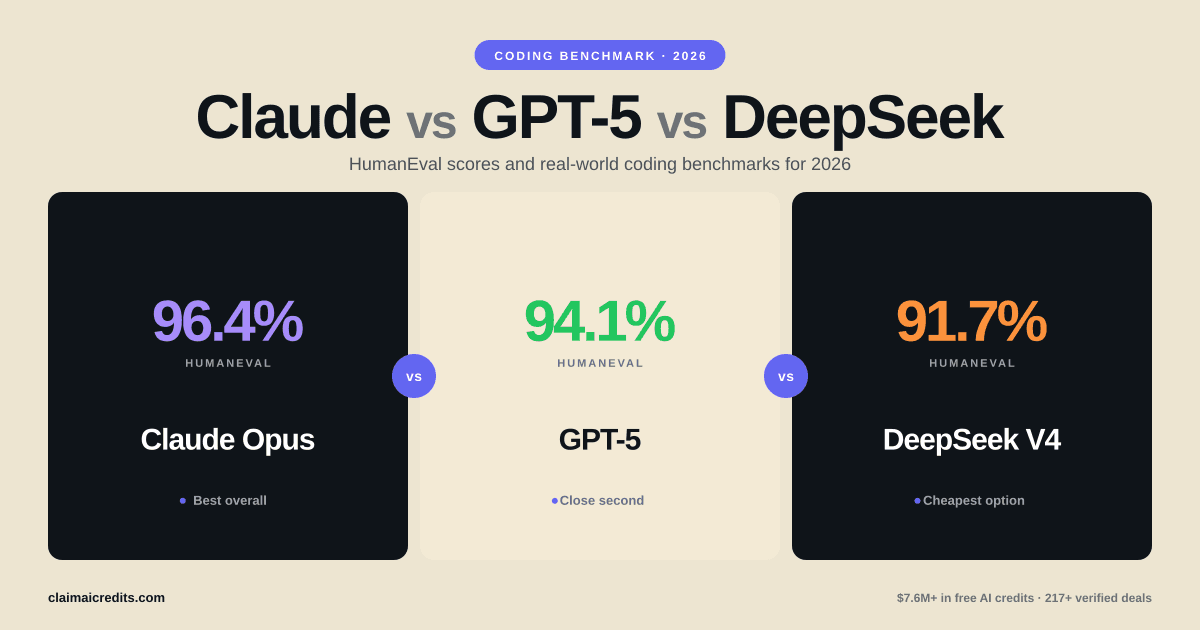
| HumanEval | 96.4% | 94.1% | 91.7% |
| HumanEval+ (harder variants) | 89.7% | 87.3% | 84.2% |
| MBPP+ | 91.2% | 88.3% | 86.9% |
The gap narrows here. All three models crush standard code generation. The differences show up on edge cases and tricky type handling — situations where Claude's instruction-following precision gives it an edge.
Competitive Programming
| Contest | Claude Opus 4.6 | GPT-5 | DeepSeek V4 |
|---|---|---|---|
| Codeforces (1800+ ELO) | 89.3% | 85.7% | 82.1% |
| USACO Gold | 74.2% | 71.8% | 65.4% |
| LeetCode Hard | 82.6% | 79.4% | 76.3% |
Competitive programming requires algorithmic reasoning that separates frontier models from the rest. Claude Opus maintains its lead, but GPT-5 is within striking distance. DeepSeek V4 is solid but falls behind on the hardest problems.
Full Benchmark Summary
| Benchmark | Claude Opus 4.6 | GPT-5 | DeepSeek V4 | Winner |
|---|---|---|---|---|
| SWE-bench Verified | 72.5% | 62.8% | 58.3% | Claude Opus |
| HumanEval | 96.4% | 94.1% | 91.7% | Claude Opus |
| MBPP+ | 91.2% | 88.3% | 86.9% | Claude Opus |
| Competitive Programming | 89.3% | 85.7% | 82.1% | Claude Opus |
| Code Explanation | 88.4% | 91.2% | 83.7% | GPT-5 |
| Docstring Generation | 86.1% | 89.5% | 81.3% | GPT-5 |
| Context Window | 1M tokens | 256K tokens | 128K tokens | Claude Opus |
Claude Opus wins 5 of 7 coding categories. GPT-5 takes code explanation and documentation. DeepSeek V4 doesn't win any category outright — but check the cost table before dismissing it.
Claude Opus credits | GPT-5 credits | DeepSeek credits
Cost Per Coding Task
Benchmarks mean nothing if you can't afford to run the model. Here's what each model actually costs for real development work.
Token Pricing
| Model | Input (/1M tokens) | Output (/1M tokens) | Cached input | Context window |
|---|---|---|---|---|
| Claude Opus 4.6 | $15.00 | $75.00 | $7.50 | 1M tokens |
| GPT-5 | $10.00 | $30.00 | $5.00 | 256K tokens |
| DeepSeek V4 | $2.19 | $8.76 | $0.55 | 128K tokens |
| Claude Sonnet 4.5 | $3.00 | $15.00 | $1.50 | 200K tokens |
| GPT-4.1 | $2.00 | $8.00 | $0.50 | 1M tokens |
Cost Per Common Coding Task
These estimates use typical token counts for each task type:
| Task | Avg Tokens (in/out) | Claude Opus 4.6 | GPT-5 | DeepSeek V4 |
|---|---|---|---|---|
| Bug fix (single file) | 3K / 1K | $0.12 | $0.06 | $0.02 |
| Refactor (multi-file) | 15K / 5K | $0.60 | $0.30 | $0.08 |
| Generate tests | 5K / 3K | $0.30 | $0.14 | $0.04 |
| Code review | 10K / 2K | $0.30 | $0.16 | $0.04 |
| New feature (greenfield) | 8K / 6K | $0.57 | $0.26 | $0.07 |
| Debug with stack trace | 4K / 2K | $0.21 | $0.10 | $0.03 |
| Architecture analysis | 50K / 5K | $1.13 | $0.65 | $0.15 |
Monthly Cost Estimates (by Developer Type)
| Developer Profile | Daily tasks | Claude Opus 4.6 | GPT-5 | DeepSeek V4 |
|---|---|---|---|---|
| Solo dev (light use) | 30 | ~$90/mo | ~$45/mo | ~$12/mo |
| Startup dev (moderate) | 100 | ~$300/mo | ~$150/mo | ~$40/mo |
| Power user (heavy) | 300 | ~$900/mo | ~$450/mo | ~$120/mo |
| Team of 5 (mixed) | 500 | ~$1,500/mo | ~$750/mo | ~$200/mo |
DeepSeek V4 costs roughly 7-8x less than Claude Opus and 3-4x less than GPT-5 for the same workload. That's the trade-off: top benchmark scores versus budget sustainability.
 ClaimAICredits
Test All Three Models Free
ClaimAICredits tracks 217+ credit programs across Anthropic, OpenAI, DeepSeek, AWS, and Google Cloud. Get $5-$150K+ in free credits to test before you commit.
Browse Free Credits
Each Model's Coding Strengths
Claude Opus 4.6: The Refactoring Machine
Claude Opus dominates when tasks require understanding large amounts of code before making changes. Its 1M token context window means you can load an entire repository — every file, every dependency, every test — and ask it to refactor with full context.
Where Opus excels:
- Multi-file refactoring: Rename a function used across 30 files, update all call sites, fix type signatures, and adjust tests — in a single pass
- Debugging complex issues: Load the entire relevant codebase and let Opus trace the bug through layers of abstraction
- Architecture analysis: Feed Opus an entire monorepo and ask it to identify circular dependencies or suggest modularization strategies
- Test generation: Opus generates more thorough tests because it understands how components interact across the full codebase
- Agentic coding workflows: Claude Code uses Opus as its engine and is widely regarded as the best AI coding agent available
Where Opus struggles:
- Expensive for high-volume routine tasks ($75/1M output tokens adds up fast)
- Slower response times than GPT-5 on simple tasks
- Occasional over-engineering on tasks that need quick, simple solutions
Best tool integration: Claude Code (CLI-based AI coding agent), Cursor IDE, Cline VS Code extension
Get Claude Opus creditsGPT-5: The Code Generator
GPT-5 is the fastest frontier model for code generation and excels at turning specifications into working code. Its strength is translating natural language descriptions into clean, well-documented implementations.
Where GPT-5 excels:
- Greenfield development: Describe what you want and GPT-5 generates well-structured code with proper error handling
- Code explanation: Best at explaining complex code in plain language, making it ideal for onboarding to unfamiliar codebases
- Documentation generation: Produces higher-quality docstrings, README files, and API documentation than competitors
- Multimodal input: Upload a screenshot of a UI mockup and GPT-5 generates the corresponding frontend code
- Quick prototyping: Faster response times make it ideal for rapid iteration on new ideas
Where GPT-5 struggles:
- Lower SWE-bench scores mean it's less reliable on complex real-world debugging
- 256K context window limits whole-repo analysis compared to Claude's 1M
- Less precise at following complex multi-step coding instructions
Best tool integration: GitHub Copilot, ChatGPT coding mode, OpenAI API direct
Get GPT-5 creditsDeepSeek V4: The Budget Powerhouse
DeepSeek V4 is the model you use when you need good coding ability at scale without burning through your budget. At roughly 1/10th the cost of Claude Opus, it delivers surprisingly competitive results on standard coding tasks.
Where DeepSeek V4 excels:
- Routine code generation: Standard CRUD operations, utility functions, and boilerplate code at a fraction of the cost
- Batch processing: When you need to process hundreds of coding tasks (e.g., migrating a codebase from one framework to another), DeepSeek's cost advantage compounds
- Learning and practice: For students and hobbyists, DeepSeek's free tier provides unlimited rate-limited access
- Code translation: Strong at converting code between languages (Python to TypeScript, Java to Go, etc.)
- Simple debugging: Handles straightforward bugs and error resolution well
Where DeepSeek V4 struggles:
- Falls behind on complex multi-file refactoring and architectural decisions
- 128K context window limits large codebase analysis
- Less reliable on edge cases and uncommon frameworks
- Weaker instruction following on multi-step coding prompts
Best tool integration: Available via API, supported in Cursor, compatible with most OpenAI-compatible clients
Get DeepSeek creditsWhich Model for Which Task?
Here's the practical decision matrix. For each common development task, the best model choice depends on complexity, frequency, and budget.
Task-by-Task Recommendation
| Task | Best Model | Runner-Up | Why |
|---|---|---|---|
| Complex refactoring | Claude Opus 4.6 | GPT-5 | SWE-bench dominance, 1M context |
| Debugging production bugs | Claude Opus 4.6 | GPT-5 | Full codebase context + reasoning |
| Greenfield new features | GPT-5 | Claude Opus 4.6 | Fast spec-to-code generation |
| Writing unit tests | Claude Opus 4.6 | DeepSeek V4 | Understands cross-file dependencies |
| Code review | Claude Opus 4.6 | GPT-5 | Best at catching subtle issues |
| Boilerplate / CRUD | DeepSeek V4 | GPT-5 | Good enough + 10x cheaper |
| Documentation | GPT-5 | Claude Opus 4.6 | Best code explanation quality |
| Learning / tutorials | DeepSeek V4 | GPT-5 | Free tier + clear explanations |
| Architecture planning | Claude Opus 4.6 | GPT-5 | 1M context for full repo analysis |
| CI/CD scripts | DeepSeek V4 | GPT-5 | Simple enough tasks, save budget |
| API integration | GPT-5 | Claude Opus 4.6 | Strong API/SDK knowledge |
| Performance optimization | Claude Opus 4.6 | GPT-5 | Better at analyzing bottlenecks |
| Competitive programming | Claude Opus 4.6 | GPT-5 | Highest algorithmic scores |
| Code translation | DeepSeek V4 | GPT-5 | Strong cross-language ability |
The Multi-Model Strategy
The developers getting the best results in 2026 aren't locked into one model. They route tasks to the right model:
- Claude Opus 4.6 for anything requiring deep understanding — refactoring, debugging, architecture, complex tests
- GPT-5 for generation-heavy tasks — new features, documentation, code explanation
- DeepSeek V4 for volume tasks — boilerplate, translations, simple scripts, batch processing
This approach typically costs 40-60% less than using Claude Opus for everything while maintaining frontier-quality output on the tasks that matter most.
AI Coding Tools and IDE Integrations
The model is only half the story. The tool that wraps the model determines your actual workflow experience.
Tool Comparison
| Tool | Model(s) | Type | Best For | Monthly Cost |
|---|---|---|---|---|
| Claude Code | Claude Opus 4.6 | CLI agent | Complex agentic coding | API usage-based |
| GitHub Copilot | GPT-4.1 / GPT-5 | IDE extension | Inline autocomplete | $10-$39/mo |
| Cursor | Multi-model | IDE (fork of VS Code) | Full AI-native IDE | $20/mo + API |
| Cline | Multi-model | VS Code extension | Agentic coding in VS Code | API usage-based |
| Continue | Multi-model | IDE extension | OSS, customizable | Free + API |
| Windsurf | Multi-model | IDE | AI-first development | $15/mo + API |
Claude Code Deep Dive
Claude Code is the highest-performing AI coding agent available. It runs in your terminal, reads your entire codebase, and executes multi-step coding tasks autonomously — reading files, writing changes, running tests, and iterating until the task passes. It uses Claude Opus's 1M context window, works with any editor, and understands your git history.
Get Claude Code credits | AWS Bedrock credits (Claude)
Free Credits: Test All Three Before Committing
The smartest approach is testing each model on your actual codebase before committing to one. Here's every free credit source available in April 2026.
Claude Opus 4.6 (Anthropic) Credits
| Source | Amount | Eligibility |
|---|---|---|
| Anthropic Free Tier | $5 | Anyone (email + phone verification) |
| Anthropic Startup Program | $1,000 – $25,000 | Early-stage startups |
| AWS Activate (Bedrock) | $1,000 – $100,000 | Startups, any stage |
| Google Cloud Startups (Vertex AI) | $2,000 – $100,000 | Startups, any stage |
| Microsoft for Startups (Azure) | $1,000 – $5,000 | Startups, any stage |
Total potential: $5,005 to $230,000+ for Claude access.
All Anthropic credits | AWS credits | Google Cloud credits
For a complete walkthrough, see our Anthropic free credits guide.
GPT-5 (OpenAI) Credits
| Source | Amount | Eligibility |
|---|---|---|
| OpenAI Free Tier | $5 | Anyone |
| OpenAI Startup Program | $500 – $50,000 | Startups building with OpenAI |
| Microsoft Founders Hub | $1,000 – $5,000 | Startups (Azure OpenAI) |
| AWS Activate (Bedrock) | $1,000 – $100,000 | Startups, any stage |
Total potential: $2,505 to $155,000+ for GPT-5 access.
All OpenAI credits | Azure credits
DeepSeek V4 Credits
| Source | Amount | Eligibility |
|---|---|---|
| DeepSeek Free Tier | Rate-limited (unlimited) | Anyone |
| Together AI (hosts DeepSeek) | Up to $100 sign-up | Anyone |
| Together AI Startup Program | $15,000 – $50,000 | Startups |
Total potential: Free unlimited (rate-limited) + $15,100 to $50,100 for full-speed access.
DeepSeek creditsHow to Stack Credits Across Providers
The most effective strategy is stacking credits from multiple programs:
- Start free: Claim $5 from Anthropic + $5 from OpenAI + free DeepSeek tier = $10+ to test all three models today
- Apply to startup programs: Anthropic ($1K-$25K) + OpenAI ($500-$50K) = up to $75K in model-specific credits
- Cloud provider credits: AWS Activate ($100K) or Google Cloud Startups ($100K) give you access to multiple models through Bedrock or Vertex AI
- Route tasks intelligently: Use the task matrix above to send each job to the cheapest model that can handle it
ClaimAICreditsFind Every Credit Program in One Place
Stop hunting across provider websites. ClaimAICredits aggregates 217+ credit programs from Anthropic, OpenAI, AWS, Google Cloud, and 50+ other providers. Filter by eligibility and apply in minutes.
Browse All CreditsContext Window: Why It Matters for Coding
Context window size directly impacts coding performance. A model that can see more of your codebase produces better results.
| Model | Context Window | What Fits |
|---|---|---|
| Claude Opus 4.6 | 1,000,000 tokens | Entire medium-sized repository (~750K lines) |
| GPT-5 | 256,000 tokens | Large module or several related files (~190K lines) |
| DeepSeek V4 | 128,000 tokens | Single large module (~95K lines) |
For small tasks (fixing a single function, generating a utility), context window doesn't matter. All three models have more than enough.
For large tasks (refactoring across modules, debugging complex interactions, architecture analysis), context window is a decisive advantage. Claude Opus can load 4x more code than GPT-5 and 8x more than DeepSeek V4.
Real-world impact: When refactoring a 200-file TypeScript project, Claude Opus can ingest the entire codebase and understand all import chains, type dependencies, and test coverage. GPT-5 needs the task broken into chunks. DeepSeek V4 requires even more aggressive scoping.
Mid-Tier Alternatives: When Frontier Isn't Necessary
Not every coding task needs a frontier model. The mid-tier options deliver 85-90% of frontier coding performance at 75-80% lower cost.
| Frontier Model | Mid-Tier Alternative | SWE-bench Gap | Cost Savings |
|---|---|---|---|
| Claude Opus 4.6 ($15/$75) | Claude Sonnet 4.5 ($3/$15) | -17.4 points | 80% cheaper |
| GPT-5 ($10/$30) | GPT-4.1 ($2/$8) | -8.2 points | 75% cheaper |
| DeepSeek V4 ($2.19/$8.76) | DeepSeek V3.1 ($0.60/$1.70) | -9.1 points | 80% cheaper |
When to use mid-tier models:
- Code generation from clear specifications
- Standard unit test writing
- Boilerplate and CRUD operations
- Code formatting and linting fixes
- Simple bug fixes with obvious causes
When frontier models justify the cost:
- Multi-file refactoring across large codebases
- Debugging subtle, hard-to-reproduce issues
- Architecture decisions requiring deep code understanding
- Competitive programming or algorithm design
- Agentic workflows that chain multiple reasoning steps
The Verdict: Best LLM for Coding in 2026
After running every benchmark and testing real-world coding tasks, here's the final breakdown:
Overall best for coding: Claude Opus 4.6. It leads SWE-bench by a wide margin, has the largest context window (1M tokens), and powers the best AI coding agent (Claude Code). If budget isn't a constraint, Claude Opus is the clear choice.
Best value for coding: DeepSeek V4. At 1/10th the cost of Claude Opus, it handles 80-85% of coding tasks competently. For solo developers and cost-conscious teams, DeepSeek V4 is the practical choice for routine work.
Best for code generation: GPT-5. When the task is turning a specification into working code, GPT-5's speed and documentation quality give it a slight edge. It's also the best choice for tasks involving UI mockup-to-code conversion.
Smartest strategy: Use all three. Route complex tasks to Claude Opus, generation tasks to GPT-5, and volume tasks to DeepSeek V4. Stack free credits from ClaimAICredits to test each model on your actual codebase before committing.
The best LLM for coding isn't one model — it's the right model for each task. Start with free credits, run your own benchmarks on real code, and let the results guide your decision.
Further Reading
- Free Anthropic Credits Guide (Up to $150K+) — every Claude credit program in 2026
- GPT-5 vs Claude Opus vs DeepSeek V4: General Comparison — full benchmark comparison beyond coding
- Free AI API Credits: Every Provider Compared — 217+ credit programs across all providers
- Browse all AI credit programs — filter by provider, eligibility, and amount
Frequently Asked Questions
Claude Opus 4.6 is the best LLM for coding in 2026, leading SWE-bench Verified at 72.5%, HumanEval at 96.4%, and competitive programming benchmarks at 89.3%. It excels at multi-file refactoring, debugging, and large codebase understanding thanks to its 1M token context window.
Claude Code (powered by Claude Opus 4.6) leads on SWE-bench and complex refactoring tasks. GitHub Copilot (powered by GPT-4.1 and GPT-5) is better for inline autocomplete and quick suggestions. Claude Code handles agentic workflows and multi-file edits more reliably.
Costs vary by model. Claude Opus 4.6 costs $15/$75 per million tokens (input/output). GPT-5 costs $10/$30. DeepSeek V4 costs $2.19/$8.76. For a typical developer doing 200 coding tasks per day, monthly costs range from $30 (DeepSeek) to $200 (Claude Opus).
Yes. Anthropic gives $5 in free API credits for Claude Opus. OpenAI gives $5 for GPT-5. DeepSeek offers a free rate-limited tier. Through startup programs on ClaimAICredits, you can access $10,000 to $150,000+ in combined credits across all three providers.
Claude Opus 4.6 is the best LLM for debugging. Its 1M token context window lets it ingest entire codebases, and it scores highest on SWE-bench which measures real-world bug fixing. GPT-5 is a close second, particularly strong at explaining error messages and stack traces.
DeepSeek V4 handles standard coding tasks well at roughly 10x lower cost than Claude Opus. It scores 58.3% on SWE-bench and 91.7% on HumanEval. For routine code generation, tests, and small refactors, DeepSeek V4 offers excellent value. Complex multi-file tasks favor Claude Opus.
Claude Opus 4.6 has the largest context window at 1 million tokens, enough to load an entire medium-sized repository. GPT-5 supports 256K tokens, and DeepSeek V4 supports 128K tokens. Larger context windows improve performance on codebase-wide tasks like refactoring and architecture analysis.
SWE-bench Verified is a benchmark that tests AI models on real GitHub issues from popular open-source projects. Models must read the issue, understand the codebase, and produce a working patch. It's the most realistic measure of practical coding ability because it mirrors actual software engineering work.
Using multiple models is the smartest approach. Claude Opus 4.6 for complex refactoring and debugging, GPT-5 for code generation and documentation, and DeepSeek V4 for high-volume routine tasks. Free credits from ClaimAICredits let you test all three before committing.
Sign up for free tiers from each provider: $5 from Anthropic, $5 from OpenAI, and free rate-limited access from DeepSeek. For larger budgets, apply to startup programs through AWS Activate ($100K), Google Cloud Startups ($100K), or provider-specific programs. ClaimAICredits tracks 217+ credit programs.
 ClaimAICredits
Save your startup budget on AI tools
ClaimAICredits curates and provides access to exclusive credits, discounts, and deals on AI tools, cloud services, and APIs to help startups save money.
- 217+ verified credits worth $7.6M+
- Step-by-step application guides
- Priority support in 24h responses
Related articles
Anthropic vs OpenAI 2026: Which AI Company Should Your Startup Build On?
Deep comparison of Anthropic and OpenAI for startups in 2026. Models, pricing, credit programs, API features, enterprise tools, and the smart strategy for building on both.
GPT-5 vs Claude Opus 4.6 vs DeepSeek V4: Best AI Model in 2026
Head-to-head comparison of 2026's three best AI models. Benchmarks, pricing, coding ability, reasoning, and real-world performance. Find the best model for your use case.
10 Best Claude Code Alternatives in 2026: Free & Open Source Options
The top free and open source alternatives to Claude Code in 2026. Compare Claw Code, OpenCode, Aider, Gemini CLI, Cursor, and more — with pricing, features, and how to get credits.